By: Jose' D. Rodrigues | Columnist | WBN NEWS Africa | November 19, 2026

NASA has achieved a major breakthrough in space exploration after successfully testing next-generation Mars helicopter rotor blades at supersonic speeds, potentially transforming how scientists explore the Red Planet.

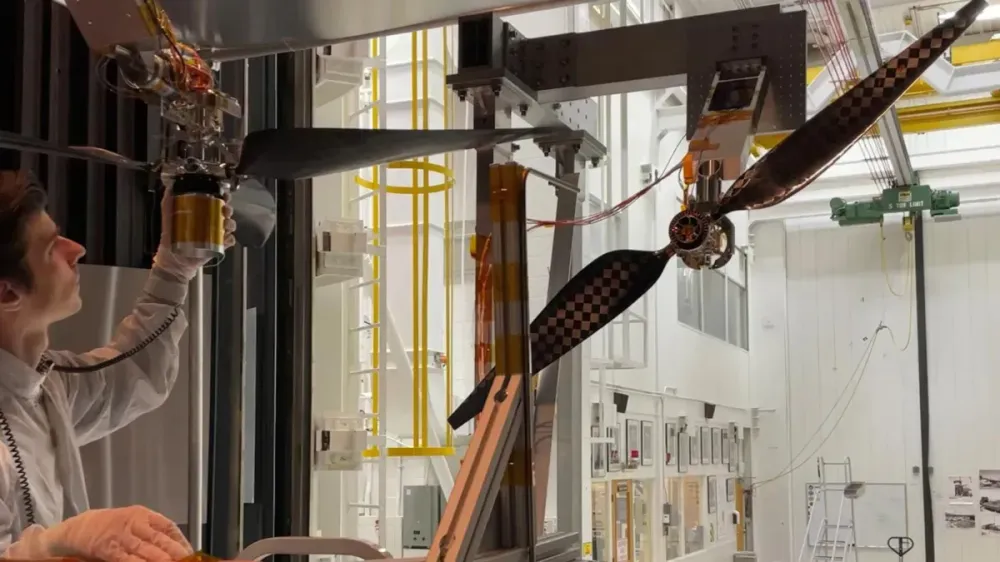
The tests, conducted in March at NASA’s Jet Propulsion Laboratory (JPL) in Southern California, demonstrated that experimental helicopter rotor tips could travel faster than the speed of sound without breaking apart. The achievement represents an important step toward developing more powerful aircraft capable of exploring challenging Martian landscapes.

During 137 test runs, engineers pushed the rotor tips to Mach 1.08, increasing the aircraft's potential lift capability by 30%. The experiments took place inside JPL’s 25-Foot Space Simulator, a specialized chamber designed to recreate the atmospheric conditions found on Mars.

Flying on Mars presents extraordinary engineering challenges because its atmosphere is approximately 1% as dense as Earth's. This makes generating sufficient lift extremely difficult, requiring helicopter blades to rotate at exceptionally high speeds.

The breakthrough builds on the historic achievements of NASA’s Ingenuity helicopter, which became the first aircraft to complete powered, controlled flight on another planet in April 2021. Ingenuity completed 72 flights, demonstrating that aerial exploration on Mars was possible.

However, NASA now wants to achieve much more.

Al Chen, Mars Exploration Program manager at JPL, explained the ambition behind the development: “NASA had a great run with the Ingenuity Mars Helicopter, but we are asking these next-generation aircraft to do even more at the Red Planet.”

The research team also expressed excitement about the results. Shannah Withrow-Maser, an aero-dynamicist at NASA’s Ames Research Center, said: “We thought we’d be lucky to hit Mach 1.05, and we reached Mach 1.08 on our last runs.”

The findings have already been incorporated into the performance specifications for NASA's SkyFall project, which is designed to deliver three next-generation Mars helicopters to the Red Planet in December 2028.

These future aircraft could carry heavier scientific instruments, advanced sensors and larger batteries, enabling longer flights and investigations in locations traditional rovers cannot easily reach.

Beyond engineering achievement, this breakthrough represents humanity's determination to explore the unknown. With every successful experiment, NASA brings scientists closer to discovering more about Mars and understanding whether the planet could one day support human exploration.

The future of space exploration is becoming increasingly exciting, and these remarkable developments offer fresh hope that discoveries once considered impossible may soon become reality.

Editor: Joseph James Udoh


WBN Global News Desk
📩 newsdesk@wbnn.news The advantage---

TAG: #Jose' D. Rodrigues #NASA #Mars Exploration #Space Science #Innovation #Technology #Space Discovery #Sky Fall

Share this article
The link has been copied!