By: Jose' D. Rodrigues | Columnist | WBN NEWS Africa | November 8, 2026

Scientists have developed an innovative filtration membrane that could transform the global oil refining industry by separating crude oil at room temperature, potentially reducing energy consumption and carbon emissions significantly.

The breakthrough, developed by an international research team led by Professor Dong-Yeun Koh of the Korea Advanced Institute of Science and Technology (KAIST), in collaboration with Professor Ryan Lively's research group at the Georgia Institute of Technology, offers a promising alternative to traditional oil refining methods.

For more than a century, conventional crude oil refining has depended heavily on distillation, a process that requires heating crude oil to temperatures above 350°C to separate its different components. This energy-intensive method contributes significantly to industrial energy consumption and greenhouse gas emissions.

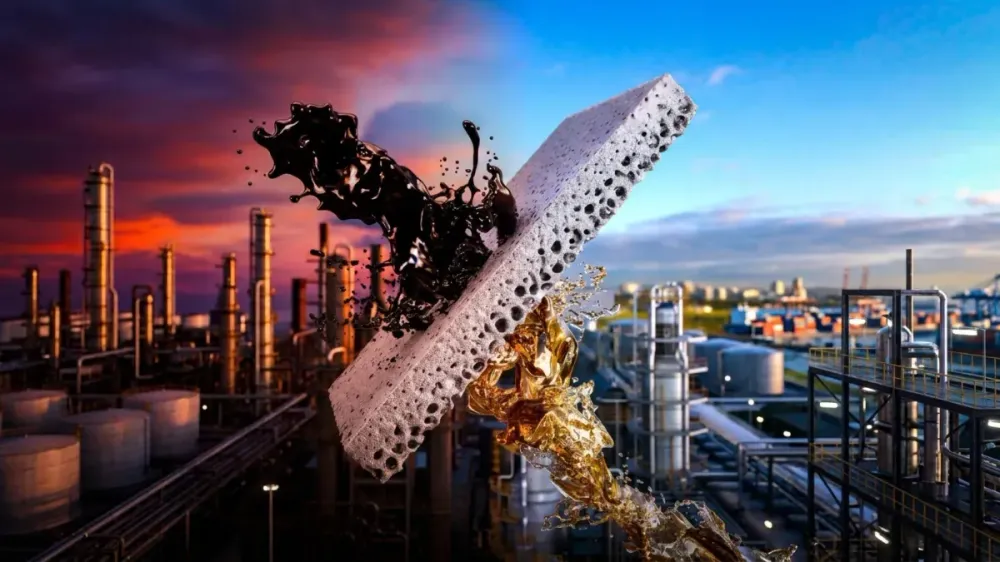
The new technology introduces a different approach using an inexpensive porous polymer membrane known as polyacrylonitrile (PAN). Remarkably, when crude oil passes through the membrane, heavier hydrocarbon molecules accumulate inside its pores, gradually forming microscopic filtration channels smaller than two nanometres.

These naturally formed channels allow lighter components, including gasoline, naphtha and kerosene, to pass through while restricting heavier substances.

Published in the prestigious scientific journal Nature on June 24, 2026, the research demonstrated that the membrane achieved separation rates more than 23 times higher than previously reported leading crude oil membranes. It also maintained stable performance for 28 consecutive days.

According to the researchers' process simulations, incorporating the technology before conventional distillation could reduce energy consumption by 31.6 per cent, carbon dioxide emissions by 37.6 per cent, cooling water consumption by 20.7 per cent and operating costs by 36 per cent.

Professor Dong-Yeun Koh explained the significance of the discovery, saying, "This study reveals a new scientific principle in which a membrane interacts with a complex mixture and spontaneously forms its own separation channels."

Professor Ryan Lively also highlighted the technology's potential to make membrane-based crude oil separation more practical for industrial adoption.

Although further development is needed to establish large-scale manufacturing and long-term reliability, the discovery represents an encouraging advancement in industrial innovation.

As the world searches for cleaner and more energy-efficient technologies, this breakthrough offers hope that scientific creativity can make essential industries more sustainable, reduce environmental pressures and create a better future for generations to come.

Editor: Joseph James Udoh


WBN Global News Desk
đź“© newsdesk@wbnn.news The advantage---

TAG: #Global News Lead #Science #Innovation #Technology #Energy #Climate #Research #Sustainability #Sources #WBN Africa #Africa Edition #WBN Africa News #WBN News Africa #Update #Africa

Share this article
The link has been copied!