By: Mapenzi Kaposho Akso | Columnist | WBN NEWS Africa | May 29, 2026
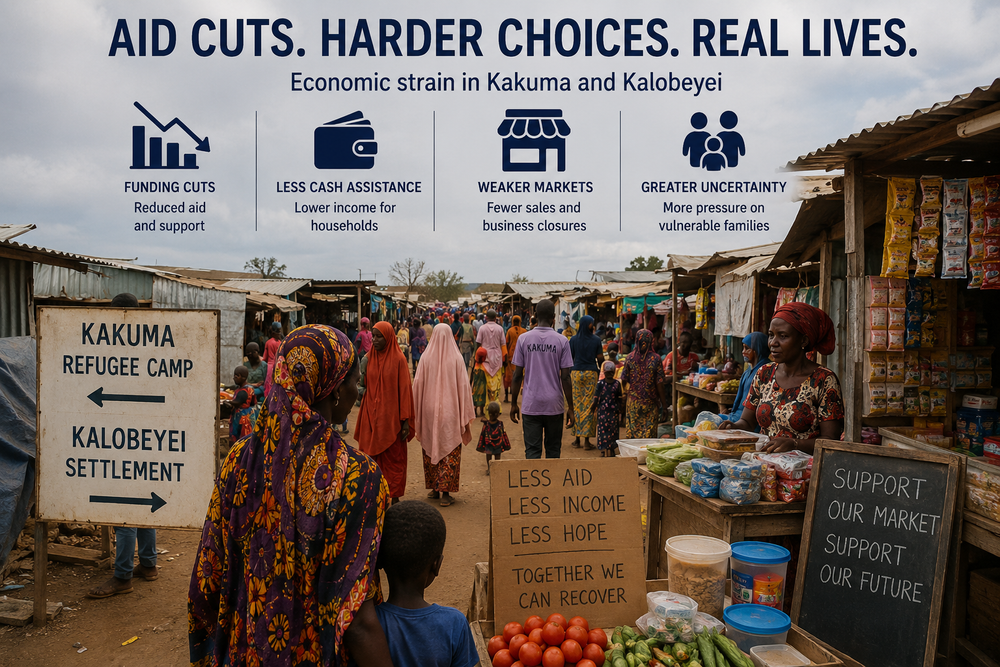
The fragile economies of Kakuma Refugee Camp and Kalobeyei Refugee Settlement in are facing mounting pressure as humanitarian funding cuts and changes in aid distribution reshape daily life for thousands of residents.
For years, cash-based assistance has supported not only refugee households but also the wider local economy. Small shops, food vendors, transport operators, and service providers have depended heavily on the circulation of humanitarian cash support within the settlements. Today, however, that flow is slowing.
A recently introduced differentiated assistance system now categorizes households according to perceived levels of vulnerability. Under the model, many families placed in Categories 3 and 4 have seen their assistance reduced or removed entirely. While the policy aims to prioritize the most vulnerable amid limited resources, many affected households still lack reliable income or sustainable livelihood opportunities.
At the same time, broader global funding constraints are affecting humanitarian operations across the region. Reduced donor contributions, including cuts linked to programs supported by the , have forced several aid organizations to scale down activities. Agencies such as the and the have also faced financial pressures affecting staffing and program delivery.
The economic consequences are already visible. Incentive workers and contracted staff play a critical role in sustaining household spending within Kakuma and Kalobeyei. As contracts end and incentives decline, purchasing power weakens, directly affecting local businesses that rely on daily consumer activity.
Several traders report slower sales, reduced customer traffic, and shrinking profits. Some small businesses have already closed, reflecting how interconnected the refugee economy has become. When one source of income disappears, the impact spreads rapidly across households and markets.
“The local economy functions as a connected system, and when income decreases for one group, the impact spreads across traders, service providers, and households.”
Observers say expectations for self-reliance among Category 3 and 4 households may not fully reflect existing realities, including limited mobility, restricted access to capital, and few formal employment opportunities.
Despite these challenges, communities in Kakuma and Kalobeyei continue to show resilience through small enterprise, community support networks, and determination to adapt. Humanitarian experts say stronger collaboration between donors, agencies, and local actors could help stabilize livelihoods and preserve economic dignity for vulnerable families in the months ahead.
Editor: Joseph James Udoh
WBN Global News Desk
📩 newsdesk@wbnn.news The advantage---
TAG: #Africa #Refugee Economy #Aid Cuts #Kakuma #Kalobeyei #Livelihoods #Cash Aid #Humanitarian #WBN #Africa Edition #WBN News #WBN News Africa