By: Joseph James Udoh | Columnist | WBN NEWS Africa | April 20, 2026
Artificial intelligence may appear as software, but its true power lies in hardware. At the core of every breakthrough, whether chatbots, image generation, or predictive systems are specialized AI chips built to process vast data at high speed and efficiency.
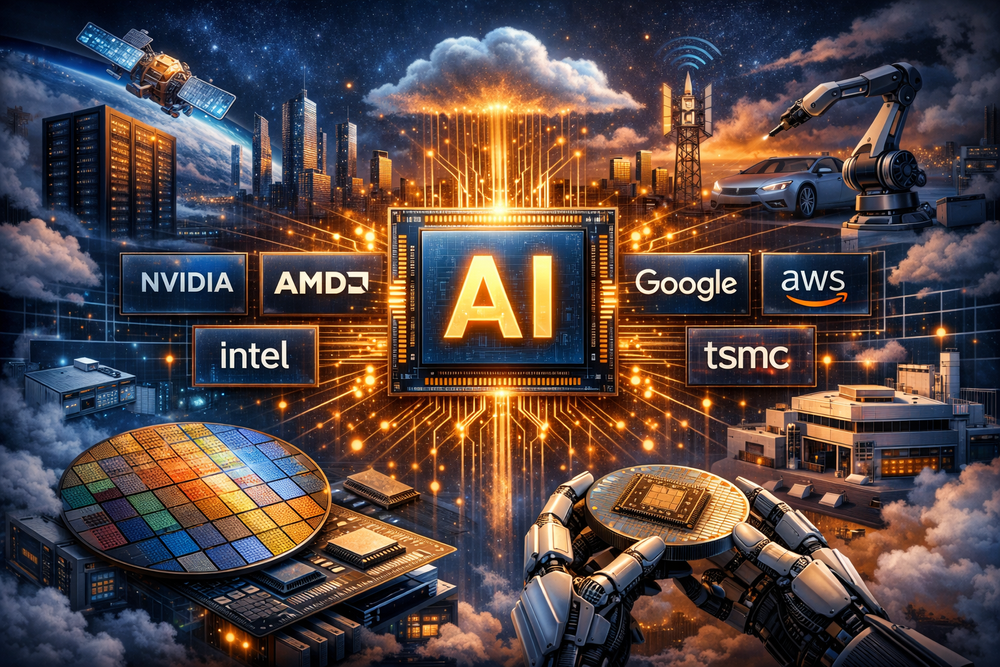
Leading this transformation is NVIDIA, whose GPUs power most large-scale AI training, supported by its CUDA ecosystem. Challengers like AMD and Intel are expanding alternatives in compute hardware, while companies such as Google and Amazon Web Services design custom chips to optimise their AI systems.
The ecosystem extends beyond raw compute. Apple and Qualcomm bring AI to billions of devices, while infrastructure players like Broadcom ensure seamless data movement. Manufacturing giants such as TSMC and Samsung Electronics make advanced chips possible at scale.
Emerging innovators, including Cerebras Systems and Groq, are pushing boundaries in speed and efficiency, showing that the future remains open to disruption.
“AI chips are what allow AI models to learn from data, make decisions, and respond in real time.”
“The AI revolution is therefore not only a software race, but a deeply physical and industrial one.”
Together, these companies form a layered global system powering modern intelligence. As demand grows, their work is not just advancing technology, it is enabling healthcare breakthroughs, smarter cities, and more inclusive digital economies. The future of AI will be built not by one company, but by the strength of this shared foundation.
WBN Global News Desk
📩 newsdesk@wbnn.news The advantage---
TAG: #AI #Tech #Chips #Innovation #Future